Meet the Author: Associate Professor Stephen Gallagher
In this insightful Q&A, we speak with Associate Professor Stephen Gallagher, author in Australian Journal of Earth Sciences, about the ground-breaking discovery behind his article, “The geology of the Twelve Apostles in the Port Campbell Embayment in southeast Australia.” .The study generated significant international media attention for revealing, for the first time, how millions of years of tectonic activity, ancient oceans, and environmental change shaped one of Australia’s most iconic natural landmarks. By analysing microscopic fossils preserved within the limestone cliffs and sea stacks, Assoc. Prof. Gallagher and his team uncovered an extraordinary 15-million-year geological archive — transforming the Twelve Apostles from a celebrated tourist destination into one of Australia’s most significant records of Earth’s climate and ocean history.
Assoc. Prof. Gallagher published his article Open Access (OA) making it free to read for all. He was able to do this through the CAUL agreement, between Taylor & Francis and Australia & New Zealand institutions, which you can read more about here.
What makes the Twelve Apostles more than just an iconic coastal landmark from a scientific perspective, and why did you see them as an important archive for reconstructing Earth’s climate and environmental history?
The Twelve Apostles are internationally renowned as a tourist icon, where most visitors take in the view and then post on social media and move to the next natural wonder. To these visitors they are gigantic rocks sticking out to the sea in a coastal setting. However, most tourists do not realize the importance of the many beautiful yellow and grey layers within these huge sea stacks. These layers are a scientifically significant record of a key period in Earth’s history from 14 to 8.6 million years ago (the Miocene Epoch). The multitude of limestone and clay layers are like tree rings that preserve evidence of changing climate, sea level and environments related to the waxing and waning of Antarctic icesheets. They were laid down during a period of global warming followed by cooling. Each layer likely preserves evidence of changes over hundreds and thousands of years. Our work has revealed that these sediment layers are one of the world’s best-preserved and accessible records of ancient climate and changes in sea levels from the Miocene Epoch.
This project brought together unpublished research from decades ago with modern analytical techniques. What do you enjoy about revisiting historical scientific data and reinterpreting it through new technology?
One of the most fun aspects of this research was the discovery of samples and data related to an unpublished PhD thesis finished in 1977 by Dr Cliff Mallett (co-author) was stored in the Museum of Victoria and archived on-line at the University of Melbourne. Added to this was the enthusiasm and willingness of Dr Mallett (retired) to become actively involved in our research fieldwork, this formed a strong basis to integrate his past work and our new work on Twelve Apostles geology.
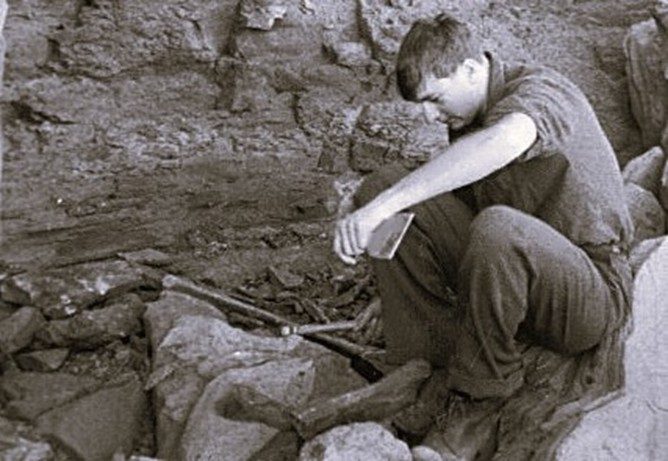
Thus, while much of the research for our paper was carried out since 2022. The journey of discovery for this research, began in the 1970’s with Dr Mallett’s PhD research. Over several field seasons along the Port Campbell coastline, precariously accessing and sampling cliff edges and steps, Dr Mallett collected hundreds of samples, to get ages of the layers. He photographically mapped (by aeroplane) the coastline to correlate the layers. Many of the localities he sampled are no longer accessible and therefore the data and samples from his work formed an invaluable treasure trove that we integrated into our work.
We relogged and resampled several localities and the coastline that was previously mapped in analogue photographic format was remapped using digital imagery. The combination of new and “old” microfossil and imagery analyses allowed us to map and date the layers along coastline of the Port Campbell region with great precision to determine the 15 million-year geological history of these iconic sea stacks.
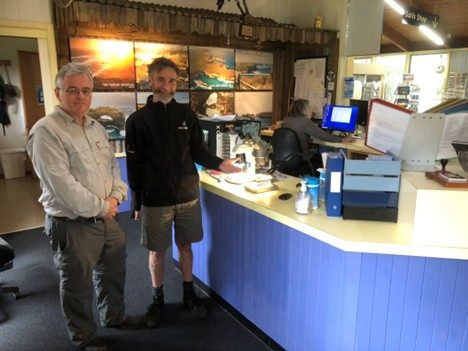
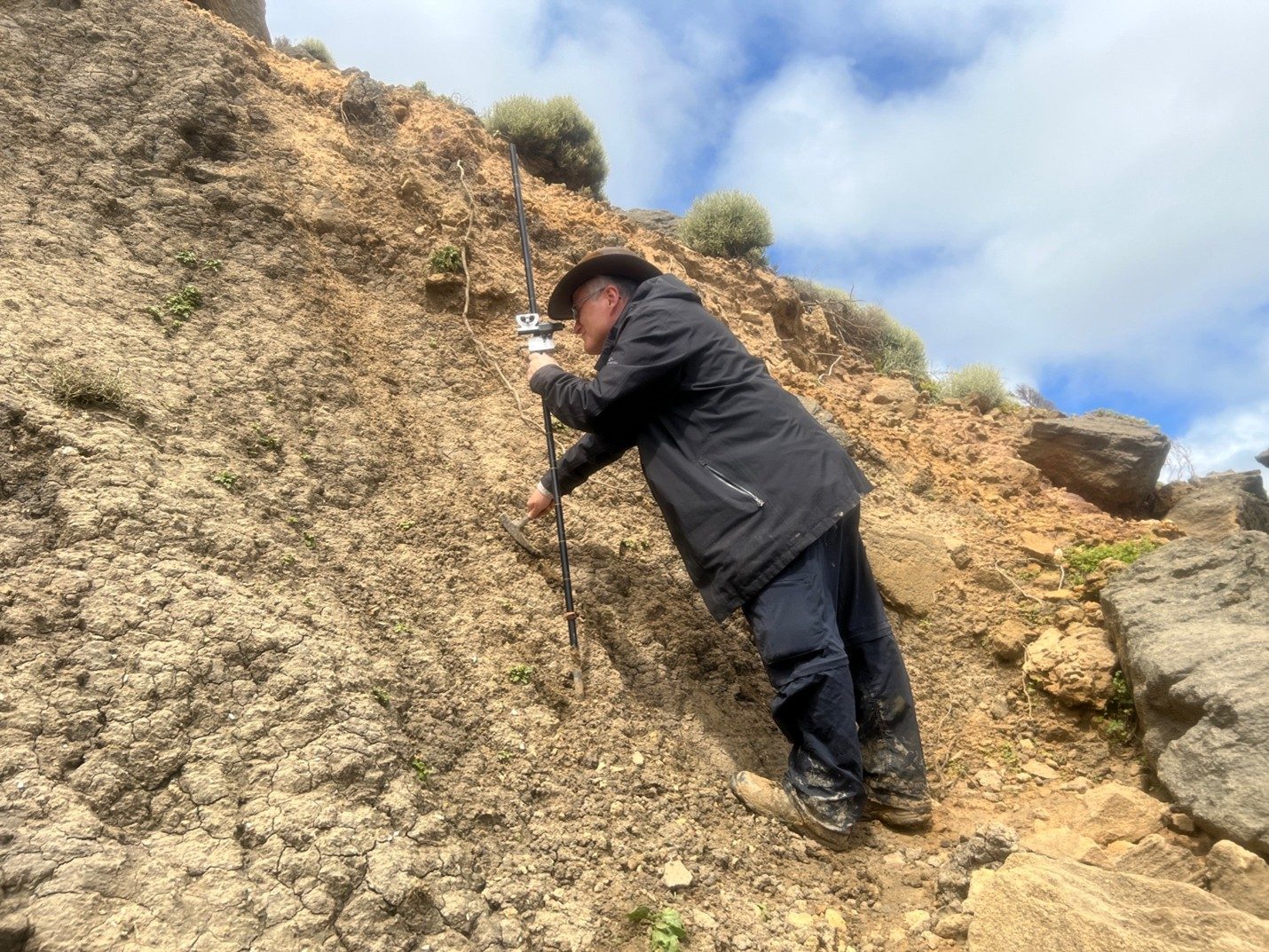
We donated microfossils from our Twelve Apostles research (and microscopes) to the Port Campbell Visitor Information Centre as part of a multi-year program of community outreach (talks and field trips). Assoc. Prof. Stephen Gallagher (left) and Mark Cuthell (right, from the Port Campbell Visitor Information Centre). Image provided by author.
What does this study reveal about the scientific value of revisiting landscapes we assume we already understand?
Prior to our paper, most interpretations of the landscape of the Twelve Apostles were based on geological maps from the early 90’s and the pioneering work of George Baker in 1945. In general, it is widely known that the layers were deposited in the Miocene Epoch and the sea stacks themselves were much younger, however, the very ubiquity and popularity of these iconic features has meant that geoscientists (myself included) over the years have assumed that research was already completed and their geology was well known. This proved not to be the case. Our past and ongoing research on the Twelve Apostles has revealed a detailed record of climate and sea level, that requires further investigation and documentation. We can now use new microscopic fossil and chemical studies to investigate in detail how Australian sea level and climate changed over thousands of years during Miocene warm and cool periods. Studies that investigate change during “short” geological intervals in warm periods in Earth history are important as they tell us how sea level and environments might respond with future climate change.
Field-based geology often requires patience and close observation over long periods of time. What is it about that process that continues to excite you as a researcher?
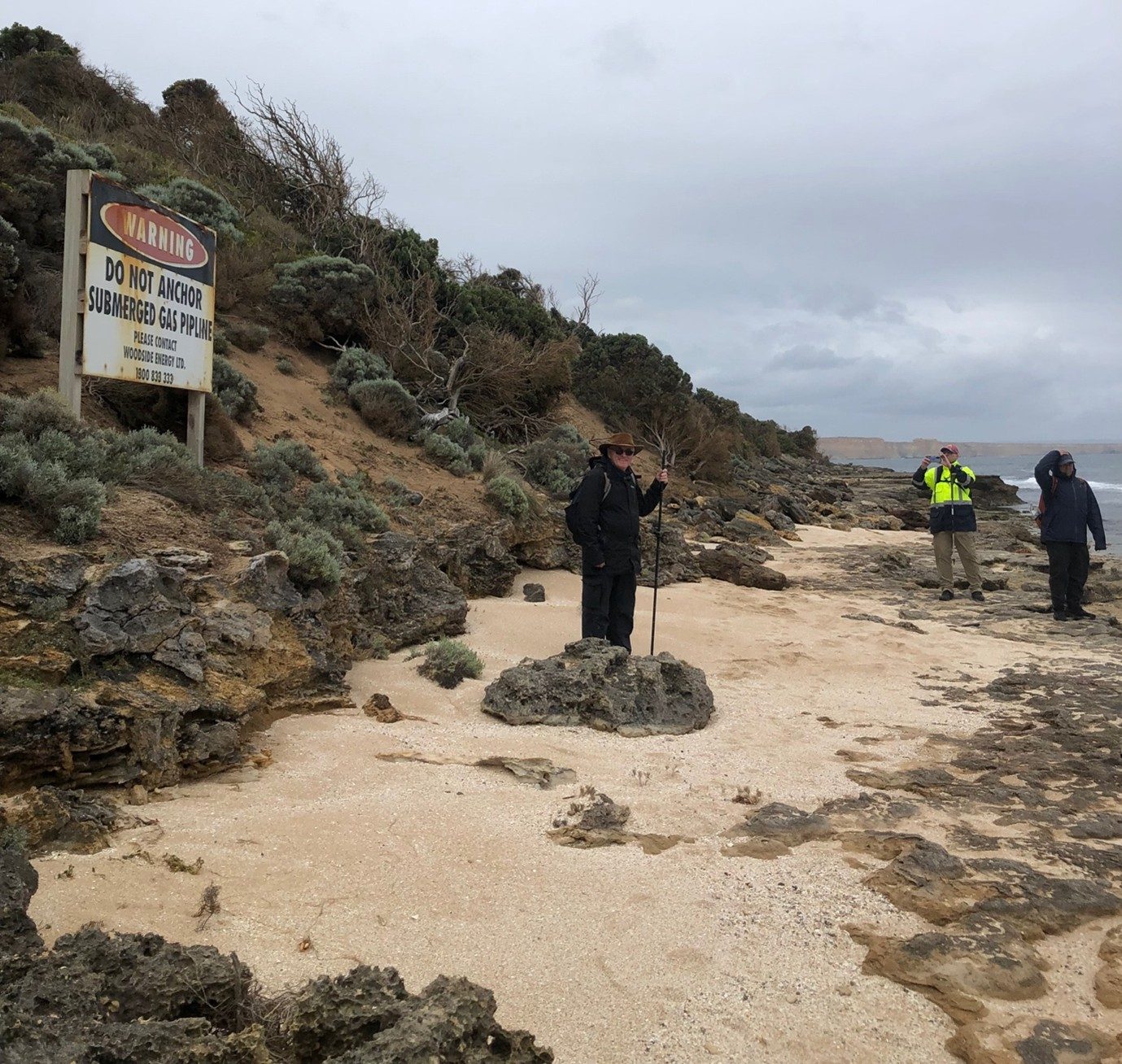
Our work was carried out via several multi-day field trips since 2022. These trips were scheduled in summer during the lowest tide periods, allowing us to access sections at beach level in areas to the East of the Twelve Apostles. The fieldwork was intense as we obtained samples and measurements every 25 cm in >50 m of layers (>200 samples!). In this way it might take a full day to measure 10 metres of layers. In addition, during our trips we experienced Southern Ocean swells and rainstorms, drenching us so much that we sometimes emerged from the field covered in mud. This makes geological fieldwork exciting and immersive. Another bonus with our intense field program is that we have got to know each centimeter of the Twelve Apostles, it is a privilege to be carrying out fieldwork in such a spectacular landscape.
Your article was published Open Access and quickly reached audiences far beyond academia through international media coverage. In your view, what role does Open Access play in connecting geological and climate research with the public, policymakers, and communities affected by environmental change?
The University of Melbourne has an Open Access agreement with Taylor and Francis, thus they covered the open access fees. I fully support such Open Access for all articles like ours that are in the public interest. This is especially true as the public partially funds the Australian higher education system. Public, policymakers, and communities need to access the results of, and appreciate the benefits of basic and applied research and how it informs our knowledge of future environmental change.
What would you say to a researcher considering publishing Open Access in an agreement such as this one with CAUL? How has this agreement supported you in producing impactful work?
Open access to our work allowed us to fully reveal our work in the public domain resulting in significant media attention nationally and internationally. We would not have been able to have this impact if the paper was behind a pay wall.
About the Journal
Australian Journal of Earth Sciences publishes peer-reviewed research papers as well as significant review articles of general interest to geoscientists. The Journal covers the whole field of earth science including basin studies, regional geophysical studies and metallogeny. There is usually a thematic issue each year featuring a selection of papers on a particular area of earth science. Shorter papers are encouraged and are given priority in publication. Critical discussion of recently published papers is also encouraged.