

Submit a Manuscript to the Journal
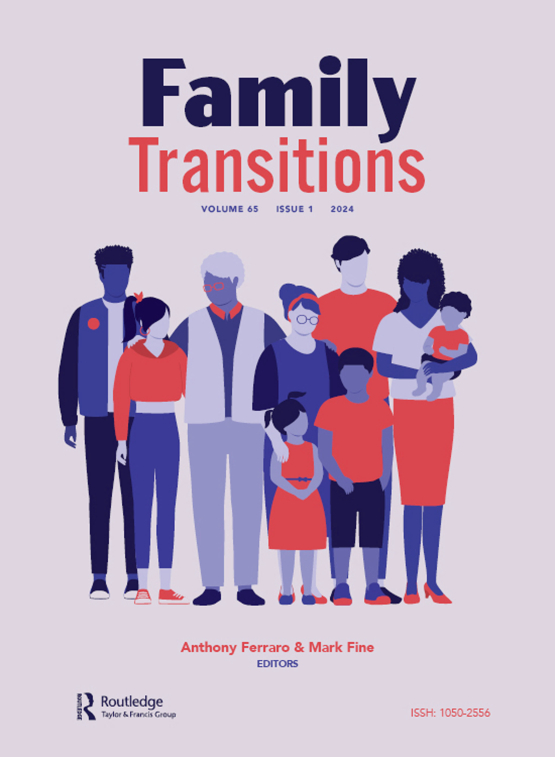
Family Transitions
For a Special Issue on
Toward Conceptual Clarity: Defining and Operationalizing Family Structure
Abstract deadline
Manuscript deadline
Special Issue Editor(s)
Mark A. Fine,
University of North Carolina at Greensboro
[email protected]
Anthony J. Ferraro,
Kansas State University
[email protected]
Luke T. Russell,
Illinois State University
[email protected]
Toward Conceptual Clarity: Defining and Operationalizing Family Structure
Our journal, Family Transitions, faces two critical scholarly challenges: a) how to theoretically define constructs related to family structure and/or transitions, and b) how to measure these constructs. In terms of scholarly definitions, most work in this area has focused on changes in how many adults assume parenting roles in the family, the addition or removal of romantic partners involved with the parenting figures, the addition or removal of stepsiblings when romantic partners enter and/or leave the family, and whether the family includes multiple generations, such as grandparents. Typically, family structure is not thought to include how family members interact with each other or how family members decide to implement their roles (i.e., family processes). Nevertheless, there are still many variables that are relevant in defining family structure or transitions and there exist numerous studies that have provided a wide range of often contrasting or inconsistent definitions. Ideally, more theoretical work is needed to reach greater scholarly clarity on how these constructs are defined, which will also spur on the development of more psychometrically sound measures.
Reliance on outdated conceptualizations that are not reflective of current family life have limited how scholars and practitioners can compare and generalize results across studies and understand modern family life. Further, the field would benefit from measures that are logically, intentionally, and consistently connected to definitions of the construct. For example, if one hypothesizes that children’s outcomes are primarily influenced by the number of parenting figures in the home (or outside the home), measures need to be developed that place a central emphasis on changes over time in the number of parenting figures living in the family. Without this level of correspondence between definitions and measures, there are substantial limitations in how far we can advance our understanding of how changes in family structure affect the adjustment of family members, particularly middle-aged children.
Purpose of this Special Issue
In this special issue of Family Transitions, we invite family scholars to submit manuscripts that review the literatures on how family structure and/or transitions have been defined and measured in the past and how we could improve the effectiveness of these processes in the future. Examples of papers appropriate for the special include those that focus on:
- Reviews of the literature on how concepts related to family structure and/or transitions have been defined and/or measured in past research;
- Theoretical or measurement development that will more effectively reflect experiences of multiple family transitions in future studies;
- Proposals for how researchers can be more deliberate in concurrently addressing both theory and measurement, because there is much less value in making contributions in only one, but not both, of these activities;
- Presentations of qualitative, quantitative, or mixed method studies that illustrate new empirical ways to better understand and measure family transitions.
Submission Instructions
There will be a combination of invited papers (written by authors who have previously made contributions to important dimensions of this area of research) and freely-submitted papers that authors believe fit the special issue’s mission. Both types of papers will follow approximately the same schedule, as outlined below.
- Interested prospective authors should submit a 1-2 page summary of what they plan to accomplish in their paper for the special issue, who will be a part of the authorship team, and how the paper fits with the goals of the special issue (August 15, 2026).
- Authors will receive feedback on whether the proposal seems to be a good fit with the mission of the special issue and, if so, suggestions for enhancing its contributions (September 15, 2026).
- For authors whose proposals were positively reviewed, submission of a complete draft of the manuscript to the Family Transitions portal (April, 15 2027).
- Anticipated publication of the special issue (Spring, 2028).
Initial proposals (due August 15, 2026) should be submitted to Anthony Ferraro ([email protected]) with the subject “Family Transitions Conceptual Clarity Special Issue Proposal.” Full manuscripts will be submitted to the special issue website for Family Transitions (submission portal will be posted before the submission deadline). For any questions pertaining to the special issue, please send inquiries to Mark Fine ([email protected]), Anthony Ferraro ([email protected]), and/or Luke Russell ([email protected]).