

Submit a Manuscript to the Journal
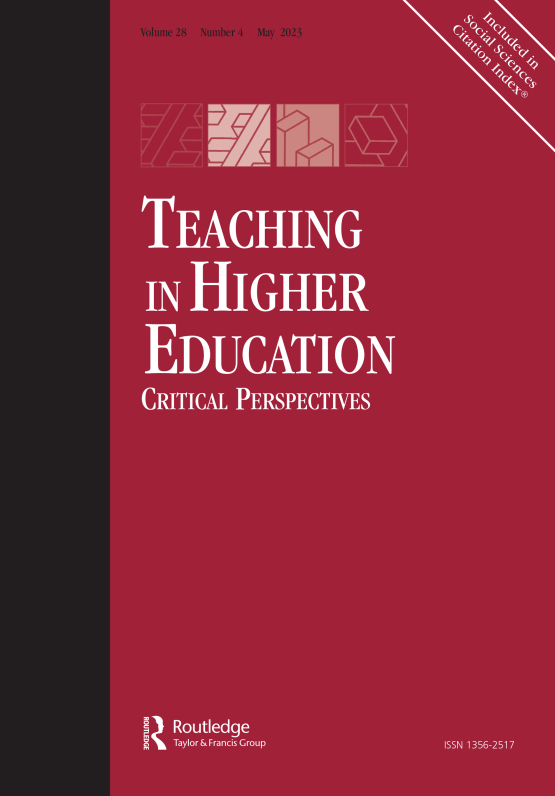
Teaching in Higher Education
For a Special Issue on
Relational pedagogies in an age of GenAI
Abstract deadline
Manuscript deadline
Special Issue Editor(s)
Karen Gravett,
University of Surrey
[email protected]
Naomi Winstone,
University of Surrey
[email protected]
Kieran Balloo,
Southern Cross University
[email protected]
Relational pedagogies in an age of GenAI
This special issue will look at relational pedagogies in contemporary digitalised higher education. We define relational pedagogies as teaching practices that attune to relationships and connections between teachers and students in higher education, and that seek to foster these in meaningful ways. Such pedagogies also work to foreground the role of emotions and affective relations within educational practices. The importance of this area of work is widely recognised as a means to think beyond competitive and individualising modes of higher education, and to work towards the development of more meaningful and inclusive education practices (Bovill 2020; Gravett et al. 2024; French et al. 2025; Su and Wood 2023).
Crucially, relational pedagogies also involve thinking about our connections with nonhuman others, such as digital technologies, spaces and objects. In this way, relational pedagogies can be understood as a more-than-human concern (Gravett et al 2024). A posthumanist relational ontology calls into question human/nonhuman binaries and casts doubt on the boundaries such binaries underpin (Gravett et al 2024; Bozalek and Romano 2025). As a result, digital technologies are understood as more than simply ‘tools’, and instead as entangled with the everyday relations of higher education (Fawns 2022).
Thinking about how we relate to both human and nonhuman others has never been more timely. Digital technologies now pervade all areas of higher education, and reshape educational practices in ways that are political, practical, and ideological. In particular, the disruptive and transformative presence of Generative Artificial Intelligence (GenAI) is rapidly reconfiguring both how educators and students engage, and the everyday practices of teaching and learning in higher education. Collaborative encounters with GenAI blur the boundaries between human and machine (Arstorp et al. 2026). Students are also increasingly engaging with GenAI to develop their learning, independently of educators. At the same time, technosolutionist discourses offer productivity promises, prompting educators to critically question the values and purposes and labour of teaching and learning. How GenAI is redefining what it means for students and educators to connect, and the role of GenAI in relational encounters become critical questions (Winstone et al. 2025). In this special issue, we ask how can we build on the current framing of relational pedagogies, to understand relational pedagogies in new ways, including how GenAI technologies are reshaping both educational practices and educators.
This special issue seeks to gather together a breadth of critical perspectives to understand relationships and relationality in contemporary times. We will consider conceptual and empirical contributions addressing key areas, such as the discourses surrounding GenAI and pedagogy; the role of relationality with respect to assessment practices; relational feedback processes; the role of care and its connection with GenAI in contemporary universities; the intersection of AI technologies with notions of mattering and belonging; research into academic work and relational connections; the materiality of education; political and ethical questions regarding digital technologies such as surveillance, datafication, agency and their impact on relationality; GenAI’s environmental impacts and how these concerns intersect with pedagogical, ethical, and political questions in education; posthuman, sociomaterial and feminist materialist perspectives; as well as contributions that seek to understand relationality in new theoretical or methodological ways. Point of Departure submissions are also welcomed. Humanist and posthumanist framings will be considered, but all abstracts should adopt a critical approach towards teaching in higher education. Abstracts without strong theorisation will not be considered. Specifically, we ask authors to engage with the ideas and provocations raised within Gravett, Winstone and Balloo’s Point of Departure article, ‘Relational pedagogies in an age of GenAI: A critical conversation’, which accompanies this Call for Papers. This article is intended to open the conversation and to elicit further debate around the theme.
The following questions aim to stimulate thinking but should not be seen as exhaustive:
- How does students’ use of GenAI, in ways that are not controlled by educators, reshape relationships and pedagogies?
- What role do emotions, affective relations, and embodied experiences play for students and educators in an age of GenAI?
- How do relational pedagogic encounters with GenAI blur the boundaries between human and machine?
- How are GenAI technologies changing relational assessment practices in higher education?
- How are relational feedback processes evolving as a result of GenAI technologies?
- What new methods are needed to understand our relationship with digital and GenAI technologies in higher education?
- What questions does GenAI raise for equity perspectives on relationality: do these processes play out the same for all students and teachers?
- What new theoretical and critical approaches are being engaged to investigate relational pedagogies and relationality in the age of GenAI, with respect to higher education?
Submission Instructions
- Abstracts of no more than 750 words (excluding references) should be submitted here by Monday 20th April 2026 (by 18.00 GMT)
- We expect that decisions on abstracts will be communicated to authors by Monday 18th May 2026.
- Invited draft full papers must be submitted through the journal’s website by Monday 26th October 2026 (by 18.00 GMT)
For advice on submitting a paper, please also see: https://teachinginhighereducation.wordpress.com/seven-questions-for-potential-authors-how-to-get-published-in-teaching-in-higher-education
For advice on submitting a Point of Departure submission please see: https://www.tandfonline.com/action/authorSubmission?show=instructions&journalCode=cthe20#article-types
If you have any queries about the special issue or your abstract, please contact Karen Gravett ([email protected]).