
Submit a Manuscript to the Journal
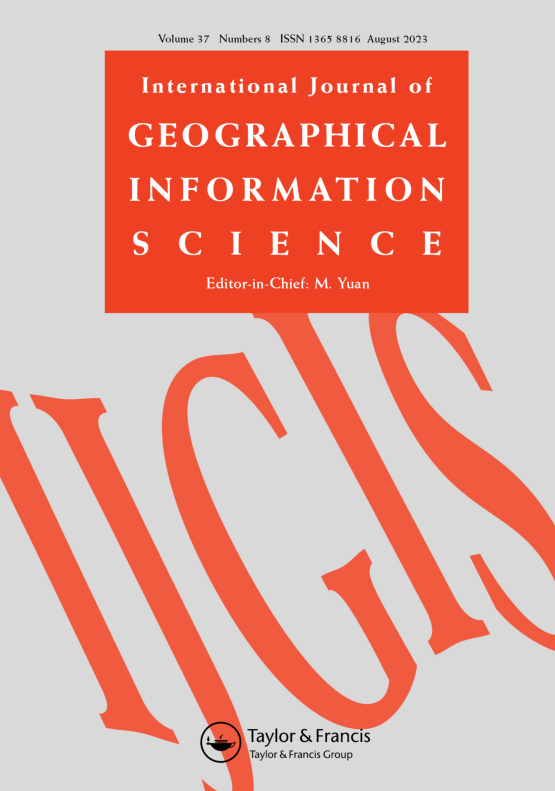
International Journal of Geographical Information Science
For a Special Issue on
Critical Challenges in GeoAI
Abstract deadline
Manuscript deadline
Special Issue Editor(s)
Wenwen Li,
Arizona State University
[email protected]
Michael F. Goodchild,
University of California, Santa Barbara
[email protected]
Shashi Shekhar,
University of Minnesota
[email protected]
Patricia Solis,
Arizona State University
[email protected]
Dylan Connor,
Arizona State University
[email protected]
Critical Challenges in GeoAI
Geospatial Artificial Intelligence (GeoAI) has rapidly emerged as a transformative force in geographic information science, enabling breakthroughs in environmental monitoring, spatial prediction, urban analytics, disaster response, and Earth system modeling. The integration of deep learning, foundation models, large language models, and multimodal AI systems into geospatial workflows has generated significant excitement and accelerated methodological innovation.
Despite this progress, fundamental questions remain insufficiently examined. The rapid adoption of GeoAI has, in some cases, outpaced careful reflection on its theoretical foundations, methodological limits, epistemological implications, environmental costs, and long-term role within spatial science. As GeoAI systems grow in scale and influence, there is an urgent need to critically assess what GeoAI has achieved, where it falls short, and how it should evolve to advance scientific discovery and responsible decision-making.
This special issue addresses the critical challenges and major opportunities defining the next generation of GeoAI. Moving beyond incremental technical improvements, we seek contributions that interrogate the conceptual, methodological, societal, and environmental foundations of the field. We invite authors to propose innovative solutions to major hurdles and chart high-value future directions for GeoAI.
We welcome manuscripts that examine, but are not limited to, the following themes:
- Theoretical foundations of GeoAI and its relationship to spatial analysis, spatial statistics, and geographic theory
- Novel methodological frameworks or breakthrough application domains that define the future trajectory of GeoAI
- Strengthening of AI breakthroughs (e.g., reasoning-capable AI) to honor "laws" of geography
- Spatialization of AI concepts, e.g., spatial transfer learning, spatial attention and transformers, spatial representation learning, spatial inductive bias, spatial diffusion models, and spatial neurosymbolic reasoning
- The role of foundation models, neural-network based world models, and large-scale pretrained models in spatial sciences
- Traditional and spatial uncertainty quantification, model robustness, and misuse risks in GeoAI applications
- Environmental, economic, and societal implications of large-scale GeoAI systems including (hyperscaler) data centers
- Educational challenges, curriculum transformation and workforce development in the age of GeoAI
- GeoAI for national priorities: accelerating science and the Genesis mission
We particularly encourage contributions that not only reflect on limitations but also advance constructive pathways forward, evaluation paradigms, hybrid modeling strategies, and interdisciplinary approaches that strengthen the scientific and societal foundations of GeoAI. Other issues such as ethics, reproducibility, transparency, generalizability, and biases, while presenting critical challenges in GeoAI, are addressed in existing IJGIS special issues. Submissions primarily focused on these topics are encouraged to consider those venues. By bringing together foundational reflection and forward-looking innovation, this special issue aims to shape a more rigorous, responsible, and impactful future for GeoAI within GIScience and beyond.
Submission Instructions
Abstracts should be submitted directly to one of the guest editors via email. Authors of accepted abstracts will be invited to submit full papers; however, such invitations do not guarantee eventual acceptance for publication. Full-paper manuscripts, including any supporting materials, should be submitted through the Taylor & Francis Submission Portal or click on Submit an article at the IJGIS website. During submission, authors must select “Special Issue” at the “Article Type” step and clearly indicate the “Critical Challenges in GeoAI” special issue in their cover letter. First-time users will need to register as authors in the system. Detailed guidelines for manuscript preparation and submission can be found in the IJGIS instructions for authors. Authors are required to include a data and code availability statement in accordance with IJGIS policies.
The International Journal of Geographical Information Science considers all manuscripts on the strict condition that they have been submitted only to the International Journal of Geographical Information Science, that they have not been published already, nor are they under consideration for publication or in press elsewhere. Authors who fail to adhere to this condition will be charged with all costs that the International Journal of Geographical Information Science incurs for their papers, and their papers will not be published. IJGIS exercises double-anonymous peer reviews. Authors should only deposit anonymous manuscripts to online depositories, including preprint archives. IJGIS cannot consider manuscripts with author information available online.