
Emerging biomedical applications of nucleic acid nanotechnologies
Submit your research to Nanomedicine
About the Article Collection
The diverse biological functions and tunable chemical, structural and mechanical properties of nucleic acids make these biopolymers highly versatile building blocks for the design of nanomaterials with a wide range of biomedical applications. Researchers across multiple disciplines are interested in leveraging these properties in the design and synthesis of nucleic acid technologies for advanced therapies, including controlled drug delivery, conditional activation of therapeutics, improved diagnostics and disease monitoring.
This Article Collection aims to showcase cutting-edge research and opinion on emerging approaches to nucleic acid nanotechnology design and synthesis, and its applications in human medicine and health. We also aim to feature discussion on challenges to the widespread adoption of nucleic acid nanotechnology in the future, such as safety, regulatory and scale-up concerns.
The collection will be of interest to engineers, academic researchers, clinicians, and other professionals working in the fields of nanotechnology, biotechnology, and translational medicine.
Topics include, but are not limited to:
Key properties of biomedical nucleic acid nanotechnologies, such as: Sequence-specific targeting, Stimulus-responsiveness, Self-assembly, Biodegradability
Nucleic acid nanotechnology for improved drug delivery.
Nucleic acid nanotechnology for personalized medicine.
Nucleic acid nanotechnology for immunotherapies.
Artificial ribozymes and switches.
Modification approaches to further enhance the chemical or structural properties of nucleic acid nanotechnology.
Nucleic acid nanotechnology-based approaches to biosensing for enhanced monitoring and diagnostic capabilities.
Advantages and disadvantages of nucleic acid nanotechnologies compared to alternative approaches.
Strategies to overcome the limitations of nucleic acid nanotechnology-based approaches, such as immunogenicity.
New computational approaches and methodologies for design and characterization of nucleic acid nanoparticles.
Concerns regarding regulation and scale-up of nucleic acid nanotechnology in healthcare.

We welcome many article types that may include the following: Original Research Articles, Clinical Trial Protocols, Reviews, Perspectives, Editorials, Drug/Vaccine/Device Evaluations.
The benefit of publishing as part of an Article Collection is that they often become a key resource, driving a research community forward. This has a synergistic effect on every article in the Collection. The articles often receive more views and higher citation numbers as the Collections receive increased promotion via social media and our marketing team.
If you are interested in contributing, or would like to learn more, then please reach out to the Commissioning Editor, Louis Selwood, who will be happy to assist.
About the Guest Advisor

Kirill Afonin
Kirill Afonin is a Professor at University of North Carolina at Charlotte. He earned his M.S. in Chemistry from Saint Petersburg State University, followed by a Ph.D. in Photochemistry from Bowling Green State University. He also obtained a Graduate Certificate in Bioinformatics, Proteomics/Genomics. Prof. Afonin subsequently completed a postdoctoral fellowship in Chemistry and Biochemistry at University of California Santa Barbara. In 2011, he joined the National Cancer Institute at the National Institutes of Health as a Research Fellow, where he established and managed an experimental branch within the Computational RNA Structure Group. In 2015, Prof. Afonin began his tenure-track appointment at UNC Charlotte. He was promoted to Associate Professor with permanent tenure in 2019 and to Full Professor in 2021. He currently serves as a founding council member and Vice President of the International Society of RNA Nanotechnology and Nanomedicine. Among his honors and recognitions, Prof. Afonin is a Senior Member of the National Academy of Inventors, a recipient of two NIH Fellows Awards for Research Excellence (FARE), and the recipient of a prestigious NIH Maximizing Investigators’ Research Award (MIRA R35), as well as two NIH R01 grants.
Submission information
Submission deadlines:
Standard track: October 1st, 2026
Accelerated Publication: December 3rd, 2026
Accelerated Publication Plus: December 31st, 2026
Reasons to publish with us
Gain recognition from an international audience and increase your opportunities for future collaboration
Receive 50 free e-prints & promotional tips on promoting your article courtesy of our Author Services site
Immediately see the impact of your research made in the community by tracking downloads, citations, and the Altmetric Score of your article on My Authored Works
Increase the discoverability of your research with MEDLINE listings and more
Accelerated Publication
If time is critical in your publishing strategy, our Accelerated Publication options are available on a select number of biomedical journals and can help you get your research into a high-quality, peer-reviewed journal, fast.
Plain Language Summaries
When you are ready to submit your article, communicate the significance of your original research in a clear language to a broad audience using Plain Language Summary.

Open Access
Open access makes published academic research freely and permanently available so anyone, anywhere can read and build upon this research. We champion researcher choice with a variety of open access publishing options to meet the unique needs of each author.
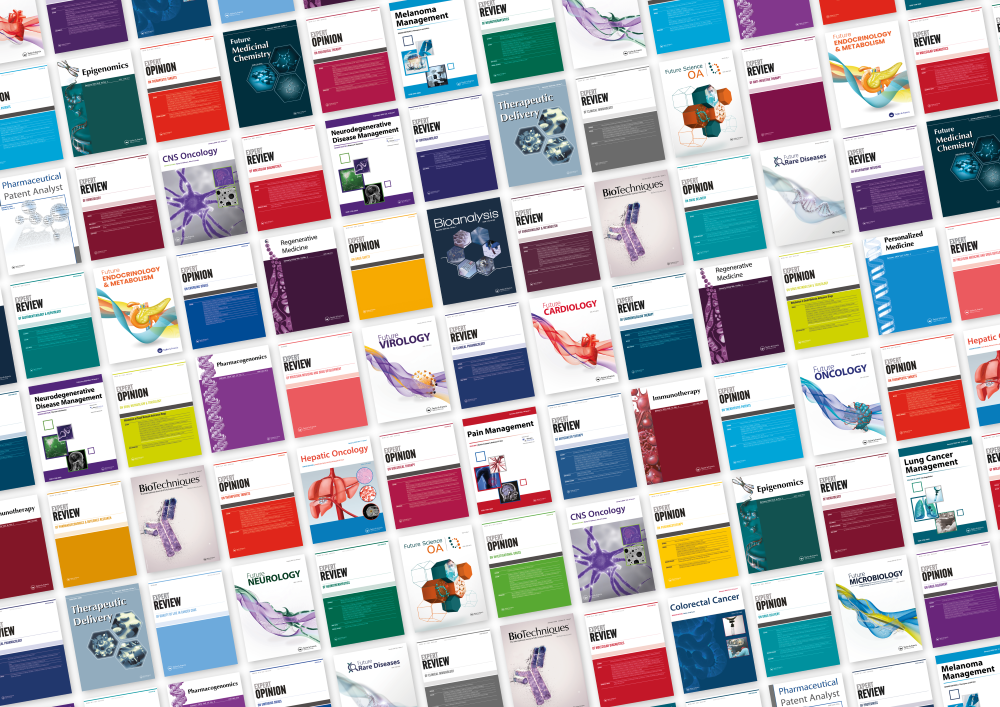
Discover the Expert Collection
The Expert Collection is the world’s largest series of review journals in clinical medicine and R&D. Expert Collection articles present the personal opinions of our authors, all internationally recognized experts in their fields. They share their insights about where research is now, where it should go next, and how it should get there.

Editing Services
Pre-submission manuscript preparation can help you maximize the impact of your research and improve the quality of your manuscript. Services include English Language Editing, Scientific Editing, Manuscript formatting, and many more!