

Editor needed for
Journal of Moral Education
Deadline
About the role
Established 55 years ago, the Journal of Moral Education is the pre-eminent international Journal in the fields of moral psychology, moral education and moral philosophy. Its contributors come from a broad range of backgrounds, including philosophy, sociology, anthropology, psychology, political and educational theory and educational practice, from across the globe. The Journal’s mission is to stimulate and provoke thought in and beyond formal education to enhance and develop analysis, understanding and response to complex moral issues and questions in the 21st century in diverse religious, non-religious and cultural contexts. It aims to bring to the attention of academics and practitioners world-leading and intellectually stimulating research and scholarship. The Journal of Moral Education is published by Taylor and Francis and has been edited by Professor Kristján Kristjánsson since 2017.
The Trustees of the Journal of Moral Education Trust are now seeking applicants for the post of Editor for a period of five years in the first instance. The Editor is accountable to the Trustees but enjoys complete editorial independence. The Editor, in consultation with the Trustees, would select an appropriate editorial team, which at present consists of internationally renowned scholars from various disciplinary and geographical backgrounds. The Journal has a close association with the Association for Moral Education and The Asia Pacific Network for Moral Education.
About the Journal
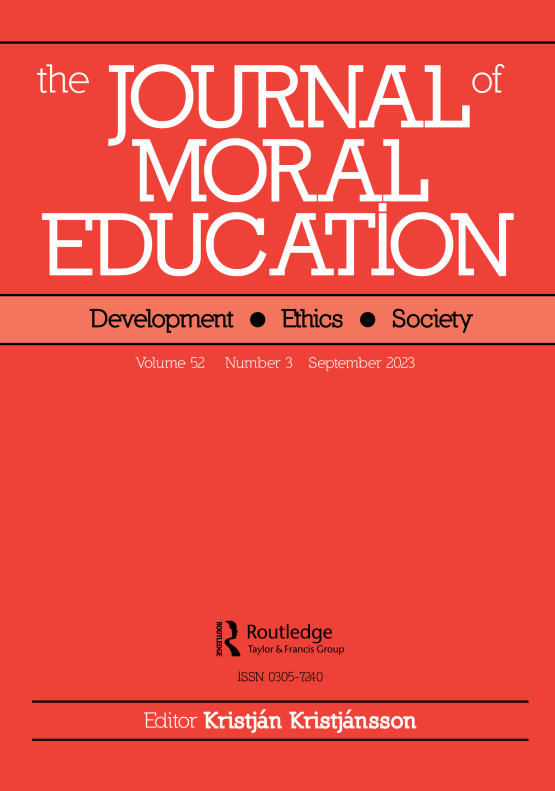
The Journal of Moral Education (a Charitable Company Limited by Guarantee) provides a unique interdisciplinary forum for the discussion and analysis of moral education and development throughout the lifespan. The journal encourages cross-disciplinary research and submissions across the human sciences and humanities that use a range of methodological approaches and address aspects of moral reasoning, moral emotions, motivation and moral action in various contexts (e.g., cultural, gender, family, schooling, community, leisure, work) and roles (e.g., parent, teacher, student, civic, professional). The journal encourages proposals for special issues that address a topic relevant to these aims and scope.
We encourage submissions including but not exclusively related to:
Anthropology of morality; Anti-racist education; Character education; Childhood studies; Citizenship and civic education; Cognitive development; Conflict studies; Critical theory; Diversity studies; Emotional development; Epistemology; Ethics; Family, studies; Gender studies; Interculturalism; International education; Leadership studies; Moral development; Moral psychology; Multiculturalism; Peace studies; Positive youth development; Professional ethics education; Service learning; Social development; Social justice; Socioemotional development; Sociology, History and Politics of moral education; Values education; Youth studies; Wisdom studies.
The journal does not normally publish papers (for example about philosophical, historical or religious themes) that have no educational or developmental component to them.
Peer Review Policy:
All research articles published in this journal have undergone rigorous peer review, based on initial editor screening and anonymized refereeing by at least two anonymous referees.
THE JOURNAL OF MORAL EDUCATION TRUST
The Journal of Moral Education Trust, established in 1997-8, is a Charity. According to its constitution its trustees are UK residents; they are currently: Jim Conroy (Chair), Neil Ferguson (Secretary/Treasurer), Brian Gates, Janet Orchard, Michael Reiss and Monica Taylor. The trustees are supported by an international advisory board of invited scholars. Its objectives are to support high quality innovative and scholarly activity and research including work in moral development, civics and citizenship education. Studies from a range of disciplinary and interdisciplinary perspectives are encouraged including (but not exhausted by) psychology, philosophy, sociology, anthropology, economics, history and literature.
The Trust’s revenue is entirely derived from income from the Journal of Moral Education (JME), which it owns. The Journal provides a unique interdisciplinary forum for the discussion and analysis of moral education and development throughout the lifespan. The Journal is administered by an Editor and team of Assistant Editors, appointed by the Trust, and supported by an international Editorial Board. Now in its 45th year, the Journal is published quarterly; one issue a year usually focuses on a special topic.
Two international organisations – The Association for Moral Education (AME) and the Asia-Pacific Network for Moral Education (APNME) – are affiliated to the Trust. Members receive JME at a specially discounted subscription rate. There are liaison representatives between these organisations and the Trust which supports some attendance and sessions at their annual conferences. In particular, the Trust jointly sponsors the AME Grant scheme to support the attendance of junior scholars.
The Trust has sought in recent years to expand and diversify the scope of its activities to support moral education and development in the UK and internationally. It has funded a number of research projects in its own right, and since 2015 has partnered with the British Academy to fund one or more small research projects annually. More recently, it has begun to organise international workshops on topics of concern to the moral education community. The Trust invites comments and suggestions for future activities in moral education. Contact: Prof. Jim Conroy [email protected]
Key Skills and Attributes
The successful candidate will be expected to:
- ensure that the Journal is published quarterly and on time
- solicit and accept high quality papers for each issue
- work closely with the editorial team to maintain a robust and reliable refereeing system
- maintain and enhance the strong cross-disciplinary character of the Journal
- maintain the international character of the Journal
- work with the Trustees to promote the Journal internationally
- enhance the Journal's citation scores and other metrics
- work closely with the Trustees to develop a robust strategy to maintain and enhance the Journal's success.
The successful application should be able to demonstrate:
- broad knowledge and experience of education and educational research (and/or social science/humanities scholarship as it pertains to education)
- understanding of the complex relationships between morality, moral and social development and education
- first-class editorial skills
- sophisticated command of English (as the Journal is an English-medium publication)
- strong interpersonal skills
- high standing in the field
- experience of engaging in world-leading scholarship.
Recompense:
The position does not carry a salary. However, the Editor will receive a generous stipend, which can be used personally and/or to engage administrative support, as agreed with the Trustees.
It is anticipated that the successful applicant will take up the post in January 2028.
Application instructions
Applicants should send a c.v. of no more than ten pages and a letter of application of no more than two pages as attachments by e-mail to the Chair of the Journal of Moral Education Trust, Professor James Conroy: [email protected] by 1 September 2026.
Did you know?
Joining a Taylor & Francis journal as an Editor or Board member brings many personal and professional benefits.
Find more roles in your subject area with our Editor Recruitment search tool.
The journal is committed to ensuring diversity, equity and inclusion within its editorial team and decision making processes. All applications will be treated as strictly confidential, and each will be judged on its merits without bias for seniority of institutional affiliation. We do not discriminate on the basis of race, color, ancestry, national origin, religion, or religious creed, mental or physical disability, medical condition, genetic information, sex (including pregnancy, childbirth, and related medical conditions), sexual orientation, gender identity, gender expression, age, marital status, military or protected veteran status, citizenship, or other protected characteristics.