
Submit a Manuscript to the Journal
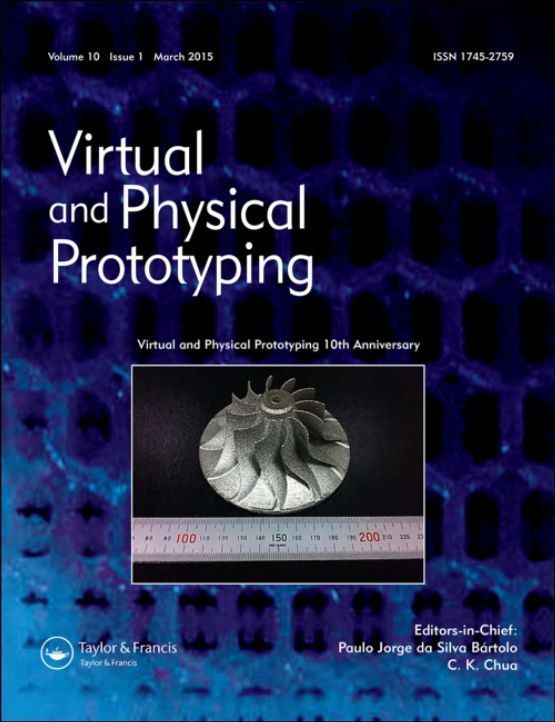
Virtual and Physical Prototyping
For an Article Collection on
Additively Manufactured Metamaterials: from Theory to Applications
Manuscript deadline

Article Collection Guest Advisor(s)
Dr. Stephen Daynes,
University of Canterbury, New Zealand
[email protected]
Dr. Ajit Panesar,
Imperial College London, UK
[email protected]
Additively Manufactured Metamaterials: from Theory to Applications
Additively manufactured metamaterials represent a rapidly evolving frontier in materials engineering, combining advanced fabrication techniques with architected microstructures to achieve unprecedented mechanical, thermal, and multifunctional properties. Unlike conventional materials, metamaterials derive their behaviour primarily from geometry rather than composition, enabling designers to tailor properties such as negative Poisson’s ratio, ultralight weight, programmable stiffness, and enhanced energy absorption. Additive manufacturing (AM) technologies—ranging from laser powder bed fusion to stereolithography—allow precise realisation of these complex structures at multiple scales, bridging the gap between theoretical designs and physical prototypes. The convergence of AM and metamaterial design is driving innovations across aerospace, biomedical, automotive, and civil engineering, providing opportunities to create highly efficient, lightweight, and multifunctional components that were previously impossible using traditional manufacturing methods. This Collection aims to capture the state-of-the-art in design, fabrication, and characterisation of additively manufactured metamaterials.
The development of additively manufactured metamaterials is critical for advancing both fundamental science and engineering practice. These materials offer unique pathways to optimise performance beyond the limits of conventional materials, enabling dramatic improvements in weight reduction, structural efficiency, and functionality. In high-value applications such as aerospace components, medical implants, and protective equipment, the ability to tailor material behaviour at the micro- and mesoscales can significantly enhance performance, reduce costs, and improve safety. Moreover, the integration of computational design, AM, and experimental validation facilitates rapid prototyping and testing, accelerating the translation of novel concepts into practical solutions. By systematically exploring the design–fabrication–characterisation chain, researchers can unlock new opportunities for multifunctional materials, contribute to sustainability through material efficiency, and support the broader adoption of AM in industrial contexts. This Collection highlights research that addresses these challenges and advances the field toward real-world impact.
This Article Collection welcomes original research, review articles, and short communications that explore the theory, design, fabrication, and application of additively manufactured metamaterials. Topics of interest include, but are not limited to, computational design methods (e.g., topology optimisation, lattice and TPMS structures), experimental characterisation and validation, mechanical and multifunctional property analysis, process–structure–property relationships, and integration of metamaterials into functional components. Articles addressing design for manufacturability, quality control, and the role of defects in AM metamaterials are also encouraged. In addition, contributions exploring applications in aerospace, biomedical, automotive, energy, and robotics that demonstrate tangible benefits of metamaterial design will be considered highly relevant. Preferred article types include full-length research articles presenting novel results, review papers summarising advances in specific subtopics, and short communications describing emerging concepts or breakthrough demonstrations. The Collection aims to provide a comprehensive resource bridging theory, simulation, and practical implementation in the field of additively manufactured metamaterials.
Keywords: Additively manufacturing; Metamaterial; Lattice structures; Mechanical properties; Multifunctional
All manuscripts submitted to this Article Collection will undergo a full peer-review; the Guest Advisor for this Collection will not be handling the manuscripts (unless they are an Editorial Board member).
Please review the journal scope and author submission instructions prior to submitting a manuscript.
The deadline for submitting manuscripts is [30 September 2026].
Please contact [Zhan Yu] at [[email protected]] with any queries and discount codes regarding this Article Collection.
Please be sure to select "Additively Manufactured Metamaterials: from Theory to Applications" from the drop-down menu in the submission system.
Dr. Stephen Daynes is an aerospace/mechanical engineer with strong international research experience in the design, analysis and optimisation of lightweight structures with a special focus on additive manufacture and composites. He is accomplished in computational mechanics (finite element analysis and structural optimisation), mechanical testing and composites manufacture. He also serves as the lead for the Aerospace Minor degree program at the University of Canterbury.
Dr. Ajit Panesar is an Associate Professor (Reader) in Computational Design for Advanced Manufacturing at Imperial College London, with a leading track record in additive manufacturing, topology optimisation, machine learning, and architected materials. He has authored the “Simulation-Driven Design” chapter for the ASM Handbook bridging the gap between research and practice, and contributed to over 60 publications, with several making it to the most downloaded/cited list. He co-leads the “Theory, Modelling and AI” SIG within the EPSRC UK Metamaterials Network, and led the “Computational Tools” theme in the EPSRC DfAM network.
Benefits of publishing open access within Taylor & Francis
Sustained readership
Publishing in an Article Collection ensures your research reaches a wide and engaged audience, driving long-term readership and citation impact.
Enhanced visibility
Gain recognition by showcasing your work in a trusted and reputable platform, amplifying your research’s visibility and influence.
Trends and methodologies
Connect with emerging topics and methodologies, positioning your research at the forefront of innovation and shaping the future of your field.
Support
Receive expert guidance at every stage of the publishing process from our experienced journal team, ensuring a seamless experience.
Network
Expand your professional network by collaborating with leading researchers from around the world, fostering interdisciplinary connections.
All manuscripts submitted to this Article Collection will undergo desk assessment and peer-review as part of our standard editorial process. Guest Advisors for this Collection will not be involved in peer-reviewing manuscripts unless they are an existing member of the Editorial Board. Please review the journal Aims and Scope and author submission instructions prior to submitting a manuscript.