Submit a Manuscript to the Journal

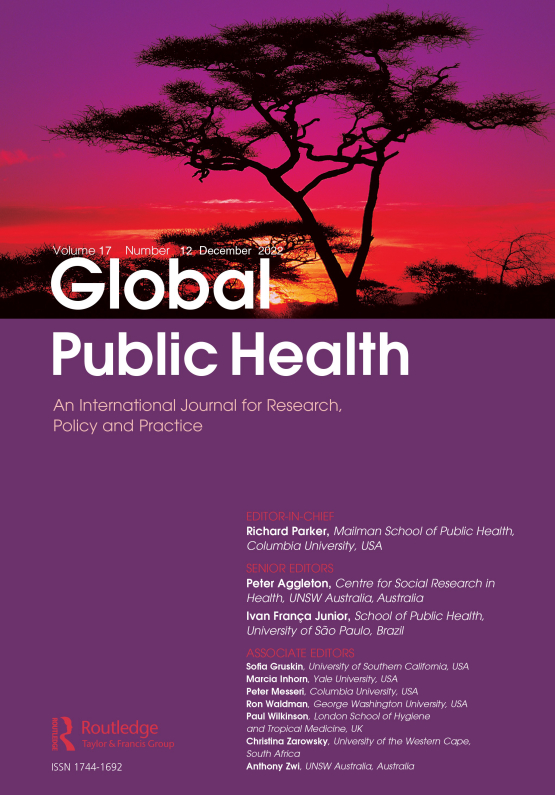
Global Public Health

For an Article Collection on

Health worker organizations as governance agents: Rethinking labor and professional advocacy in a global context

Manuscript deadline

Article Collection Guest Advisor(s)

Dr. Veena Sriram, University of British Columbia
[email protected]

Dr. Sorcha A. Brophy, Columbia University
[email protected]

Prof. Arima Mishra, School of Development, Azim Premji University
[email protected]

Journal information

Submit an article to Global Public HealthView Global Public Health on Taylor & Francis OnlineRead the Instructions for Authors on Global Public Health

Health worker organizations as governance agents: Rethinking labor and professional advocacy in a global context

Representative health worker organizations (RHWOs), including unions, professional associations, and other organized groups representing health workers, play a crucial yet surprisingly undertheorized and underexplored role in global public health. Since the onset of the COVID-19 pandemic, there has been a marked rise in labour mobilization, as health workers have increasingly turned to collective action to address both immediate pandemic-related challenges and longstanding grievances tied to underinvestment and austerity (Brophy et al. 2022; Sriram and Brophy 2022; Sharma et al. 2024). Protest and strike actions, in particular, have become more prominent tools of advocacy, with health worker strikes causing substantial disruptions to health services in numerous countries (Manguele et al. 2025). These trends are further complicated by entrenched professional hierarchies, as some RHWOs, particularly those representing physicians, advance policy objectives centred on protection and occupational closure. At the same time, rising mistrust in health systems, and heightened political polarization have contributed to growing tensions between health workers and the public. RHWOs, particularly medical associations, have drawn on their position as key interfaces with different societal groups to address a range of concerns, from violence against health workers to health mis- and dis-information.
RHWOs are critical governance actors shaping responses to a wide range of health and public policy challenges, with direct implications for access, quality, and equity. Recent structural transformations in healthcare, including the increasing reliance on contractual labour, expanding privatization, and the growing incorporation of digital strategies and artificial intelligence, have (re)invigorated these organizations as central players in health politics and governance. At the same time, RHWOs have consistently been major players in health systems and workforce governance on topics including health reform, scope of practice, working conditions and compensation, and violence against health workers. Despite their rising importance, however, scholarly engagement with RHWOs remains limited. Existing research is heavily concentrated in the Global North, with insufficient attention to the diverse institutional and political contexts of the Global South, as well as to transnational dynamics. This imbalance constrains our ability to understand how different cadres of health workers mobilize, the strategies they adopt, and their relative effectiveness in shaping policy and governance processes. Ultimately, these processes shape the direction of health systems and policy, and it is crucial that we understand how and why.
Moreover, there is a pressing need to examine emerging forms of labour organization that cut across traditional professional boundaries, and that illuminate how social and professional hierarchies rooted in trainee status, gender, race, class and other factors shape both organizing strategies and outcomes. Such inquiry is especially important in light of the deepening linkages between labour and broader social movements, which are redefining the landscape of RHWOs.
RHWOs are critical governance actors shaping responses to a wide range of health and public policy challenges, with direct implications for access, quality, and equity. Recent structural transformations in healthcare, including the increasing reliance on contractual labour, expanding privatization, and the growing incorporation of digital strategies and artificial intelligence, have (re)invigorated these organizations as central players in health politics and governance. At the same time, RHWOs have consistently been major players in health systems and workforce governance on topics including health reform, scope of practice, working conditions and compensation, and violence against health workers. Despite their rising importance, however, scholarly engagement with RHWOs remains limited. Existing research is heavily concentrated in the Global North, with insufficient attention to the diverse institutional and political contexts of the Global South, as well as to transnational dynamics. This imbalance constrains our ability to understand how different cadres of health workers mobilize, the strategies they adopt, and their relative effectiveness in shaping policy and governance processes. Ultimately, these processes shape the direction of health systems and policy, and it is crucial that we understand how and why.
Moreover, there is a pressing need to examine emerging forms of labour organization that cut across traditional professional boundaries, and that illuminate how social and professional hierarchies rooted in trainee status, gender, race, class and other factors shape both organizing strategies and outcomes. Such inquiry is especially important in light of the deepening linkages between labour and broader social movements, which are redefining the landscape of RHWOs.

Keywords: Health politics, Representative health worker organizations (RHWOs), Health governance, Organized labour, Advocacy

Dr. Veena Sriram is an Assistant Professor and Canada Research Chair (Tier 2) in Global Health Policy at the University of British Columbia. Her research examines how power, politics, and collective actors, particularly health worker organizations such as professional associations, shape health policy and governance, with a focus on the Global South. Using qualitative and interdisciplinary approaches, she has examined issues such as medical power, health worker protests, the political economy of workforce policy, and the role of private and collective actors in shaping health systems.

Dr. Sorcha A. Brophy is an Assistant Professor in the Department of Health Policy and Management at the Mailman School of Public Health, Columbia University. Her research agenda focuses on politics within representative health worker organizations and on health workforce challenges. Her recent work can be found in management, policy, and sociology outlets including Social Science and Medicine, BMC Health Services, JAMA Network Open, the Bulletin of the World Health Organization, Hastings Center Report, BMJ, BMJ Global Health, and the Journal of Health Politics, Policy and Law.

Prof. Arima Mishra is a trained medical anthropologist, working at the theoretical and methodological intersections of social sciences (anthropology) and public health. Her research and teaching interests include power and politics in health policy and systems, health equity, medical pluralism among others.


All manuscripts submitted to this Article Collection will undergo desk assessment and peer review if they can pass the desk assessments as part of our standard editorial process; the Guest Advisor for this Collection will not be handling the manuscripts (unless they are an Editorial Board member).

The deadline for submitting manuscripts is 5 April 2027.

Please contact Saniya Qureshi at [email protected]  with any queries and discount codes regarding this Article Collection.

Benefits of publishing open access within Taylor & Francis

Global marketing and publicity, ensuring your research reaches the people you want it to.

Article Collections bring together the latest research on hot topics from influential researchers across the globe.

Rigorous peer review for every open access article.

Rapid online publication allowing you to share your work quickly.

Looking to Publish your Research?

Find out how to publish your research open access with Taylor & Francis Group.

Understand more about Open Access on our Author Services website

All manuscripts submitted to this Article Collection will undergo desk assessment and peer-review as part of our standard editorial process. Guest Advisors for this Collection will not be involved in peer-reviewing manuscripts unless they are an existing member of the Editorial Board. Please review the journal Aims and Scope and author submission instructions prior to submitting a manuscript.