

Submit a Manuscript to the Journal
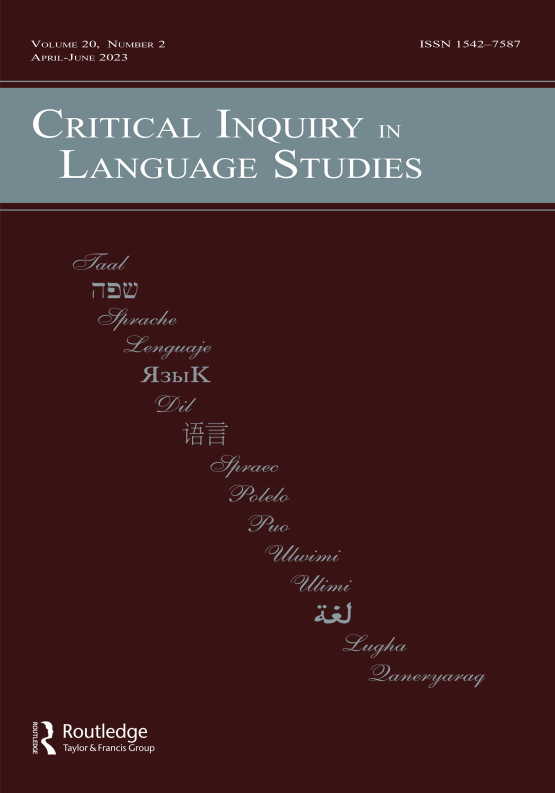
Critical Inquiry in Language Studies
For a Special Issue on
Critical Inquiry into Trans-speakerism
Abstract deadline
Manuscript deadline
Special Issue Editor(s)
Takaaki Hiratsuka,
Ryukoku University
[email protected]
Luis Javier Pentón Herrera,
VIZJA University
[email protected]
Critical Inquiry into Trans-speakerism
Call for Proposals
Guest Editors: Takaaki Hiratsuka and Luis Javier Pentón Herrera
Critical Inquiry in Language Studies (CILS) invites abstracts for a special issue entitled “Critical Inquiry into Trans-Speakerism.” Trans-speakerism is a stance in language education that replaces ‘native-speaker’ privilege with fair recognition of all speakers/teachers. In practical terms, it means focusing on effective communication and professional competence by referring to speakers, including teachers, as individual professionals rather than native/nono-native labels (Hiratsuka, 2024a).
In this sense, trans-speakerism acts as both an empowering ideological stance and an evolving practice. As an ideology, it is committed to advancing diversity, equity, and inclusion for all language speakers irrespective of their linguistic origin. As a practice, trans-speakerism enables individuals to use, learn, speak, sign, and write with their full linguistic identity repertoires (Hiratsuka, 2024a). It constitutes a personalized and contextualized approach that dynamically champions who language speakers are and what they do currently, as well as who they can be and what they can do in the future, by prioritizing their respective strengths, interests, and uniqueness—as Global Speakers of Englishes (GSEs), Global Teachers of Englishes (GTEs), and Global Englishes Researchers (GERs) (see Anand et al., 2025; Hiratsuka, 2024a, 2024b, 2025a, 2025b).
Although this definition foregrounds speakerhood as a key site of critique, trans-speakerism is not restricted to oral speech or narrowly defined speaker identities. Rather, it puts forth a wider framework for interrogating how legitimacy, authority, and participation are distributed across communicative roles and modalities, including writing, listening, interaction, assessment, evaluation, and institutional recognition. Building on long-standing critiques of native-speakerism and its experiential, pedagogical, material, ideological, and institutional consequences in language education (e.g., Calafato, 2019; Holliday, 2006; Jenks & Lee, 2019; Kim & Cho, 2022; Ruecker, 2011; Selvi et al., 2023; Yazan et al., 2023; Yuan, 2019), this special issue endeavors to advance critical, empirically grounded, and theoretically generative engagements by proposing trans-speakerism as both an analytical lens and a justice-oriented praxis (see Canagarajah, 2023).
Recent scholarship has underlined the need to progress past binary and hierarchical categorizations of language users by foregrounding professional expertise, Global Englishes knowledge, intercultural awareness, and situated practice (Baker, 2012; Coombe et al., 2020; Galloway & Rose, 2015; Losey & Shuck, 2021). At the same time, parallel developments in translanguaging, translingualism, raciolinguistic inquiry, and disability studies have drawn attention to the persistence of linguistic stratifications, symbolic violence, ableist norms, and institutional exclusions across educational, social, professional, and cultural domains (see García & Li, 2014; Dovchin, 2022, 2024, 2025; Dovchin et al., 2023; Dovchin & Wang, 2024; Kangas, 2014; Sah, 2020, 2022; Sah et al., 2026; Tarrayo et al., 2021; Wang & Dovchin, 2023). Trans-speakerism aspires to promote these affordance-oriented presumptions and contests these deficit-oriented discourses by accentuating access, accommodation, and the legitimacy of multifaceted linguistic identities. Furthermore, trans-speakerism resonates strongly with Indigenous and decolonial perspectives that counter colonial language orderings, epistemic erasure, and monolingual or monocultural standards of authority and instead highlight pluralism, reciprocity, and experiential knowledge (see Albury, 2015; Kubota & Miller, 2017; Meighan, 2023; Pennycook, 2022; Shin, 2011). Responding to these converging strands, this special issue explores how trans-speakerism can inform theory, research, practice, and policy across the heterogeneous landscape of language education and language studies, including—but not limited to—teacher education, professional development, leadership, curriculum design, digital learning environments, and institutional transformation.
References
Albury, N. J. (2015). Objectives at the crossroads: Critical theory and self-determination in indigenous language revitalization. Critical Inquiry in Language Studies, 12(4), 256–282. https://doi.org/10.1080/15427587.2015.1096732
Anand, S., Siriwardana, L. S., & Pentón Herrera, L. J. (2025). Textualizing our journeys: Dialogic explorations of trans-speakerism as diversity, equity, and inclusion. In T. Hiratsuka (Ed.), Trans-speakerism: A collection of empirical explorations (pp. 19–32). Routledge.
Baker, W. (2012). From cultural awareness to intercultural awareness: Culture in ELT. ELT Journal, 66(1), 62–70. https://doi.org/10.1093/elt/ccr017
Calafato, R. (2019). The non-native speaker teacher as proficient multilingual: A critical review of research from 2009-2018. Lingua, 227, 102700. https://doi.org/10.1016/j.lingua.2019.06.001
Canagarajah, S. (2023). Decolonization as pedagogy: A praxis of ‘becoming’ in ELT. ELT Journal, 77(3), 283–293. https://doi.org/10.1093/elt/ccad017
Coombe, C., Anderson, N., & Stephenson, L. (Eds.). (2020). Professionalizing your English language teaching. Springer.
Dovchin, S. (2022). Translingual discrimination. Cambridge University Press.
Dovchin, S. (2024). Beyond translingual playfulness: Translingual precarity. Language in Society, 54(4), 609–636. https://doi.org/10.1017/S0047404524000708
Dovchin, S. (2025). Heritage language anxiety and racialized linguistic shame. Critical Inquiry in Language Studies. https://doi.org/10.1080/15427587.2025.2593820
Dovchin, S., Gong, Q., Dobinson, T., & McAlinden, M. (Eds.). (2023). Linguistic diversity and discrimination: Autoethnographies from women in academia. Routledge.
Dovchin, S., & Wang, M. (2024). The resistance to translanguaging, spontaneous translanguagers, and native speaker saviorism. Critical Inquiry in Language Studies, 21(4), 429–446. https://doi.org/10.1080/15427587.2024.2336469
Galloway, N., & Rose, H. (2015). Introducing Global Englishes. Routledge.
García, O., & Li, W. (2014). Translanguaging: Language, bilingualism and education. Palgrave Macmillan.
Hiratsuka, T. (2024a). Native-speakerism and trans-speakerism: Entering a new era. Cambridge University Press.
Hiratsuka, T. (2024b). Native-speakerism and trans-speakerism in ELT: Interpretations, manifestations, and ramifications. System, 128. https://doi.org/10.1016/j.system.2024.103543
Hiratsuka, T. (2025a). Native English-speaking teachers (NESTs) on trans-speakerism in Japan. Critical Inquiry in Language Studies. https://doi.org/10.1080/15427587.2025.2579269
Hiratsuka, T. (Ed.). (2025b). Trans-speakerism: A collection of empirical explorations. Routledge.
Holliday, A. (2006). Native-speakerism. ELT Journal, 60(4), 385–387. https://doi.org/10.1093/elt/ccl030
Jenks, C. J., & Lee, J. W. (2019). Native speaker saviorism: A racialized teaching ideology. Critical Inquiry in Language Studies, 17(3), 186–205. https://doi.org/10.1080/15427587.2019.1664904
Kangas, S. E. N. (2014). When special education trumps ESL: An investigation of service delivery for ELLs with disabilities. Critical Inquiry in Language Studies, 11(4), 273–306. https://doi.org/10.1080/15427587.2014.968070
Kim, H. K., & Cho, H. (2022). Transnational teacher educators’ critical reflection on multilingualism. Critical Inquiry in Language Studies, 19(3), 264–285. https://doi.org/10.1080/15427587.2022.2086551
Kubota, R., & Miller, E. R. (2017). Re-examining and re-envisioning criticality in language studies: Theories and praxis. Critical Inquiry in Language Studies, 14(2-3), 129–157. https://doi.org/10.1080/15427587.2017.1290500
Losey, K. M., & Shuck, G. (Eds.). (2021). Plurilingual pedagogies for multilingual writing classrooms: Engaging the rich communicative repertoires of US students. Routledge.
Meighan, P. J. (2023). Colonialingualism: Colonial legacies, imperial mindsets, and inequitable practices in English language education. Diaspora, Indigenous, and Minority Education, 17(2), 146–155. https://doi.org/10.1080/15595692.2022.2082406
Pennycook, A. (2022). Critical applied linguistics in the 2020s. Critical Inquiry in Language Studies, 19(1), 1–21. https://doi.org/10.1080/15427587.2022.2030232
Ruecker, T. (2011). Challenging the native and nonnative English speaker hierarchy in ELT: New directions from race theory. Critical Inquiry in Language Studies, 8(4), 400–422. https://doi.org/10.1080/15427587.2011.615709
Sah, P. K. (2020). Reproduction of nationalist and neoliberal ideologies in Nepal’s language and literacy policies. Asia Pacific Journal of Education, 41(2), 238–252. https://doi.org/10.1080/02188791.2020.1751063
Sah, P. K. (2022). English as a medium of instruction, social stratification, and symbolic violence in Nepali schools: Untold stories of Madhesi children. In L. Adinolfi, U. Bhattacharya, & P. Phyak (Eds.), Multilingual Education in South Asia: At the intersection of policy and practice (pp. 50–68). Routledge.
Sah, P. K., Rakhshandehroo, M., & Oo, M. K. (2026). Feeling race in English language teaching: Racialized emotions in Japanese higher education. Critical Inquiry in Language Studies. https://doi.org/10.1080/15427587.2026.2616308
Selvi, A. F., Yazan, B., & Mahboob, A. (2023). Research on “native” and “non-native” English-speaking teachers: Past developments, current status, and future directions. Language Teaching, 57(1), 1–41. https://doi.org/10.1017/S0261444823000137
Shin, H. (2011). Rethinking TESOL from a SOL’s perspective: Indigenous epistemology and decolonizing praxis in TESOL. Critical Inquiry in Language Studies, 3(2-3), 147–167. https://doi.org/10.1080/15427587.2006.9650844
Tarrayo, V., Ulla, M. B., & Lekwilai, P. (2021). Perceptions toward Thai English: A study of university English language teachers in Thailand. Critical Inquiry in Language Studies, 18(4), 374–397. https://doi.org/10.1080/15427587.2021.1919113
Wang, M., & Dovchin, S. (2023). “Why should I not speak my own language (Chinese) in public in America?”: Linguistic racism, symbolic violence, and resistance. TESOL Quarterly, 57(4), 1139–1166. https://doi.org/10.1002/tesq.3179
Yazan, B., Pentón Herrera, L. J., & Rashed, D. (2023). Transnational TESOL practitioners’ identity tensions: A collaborative autoethnography. TESOL Quarterly, 57(1), 140–167. https://doi.org/10.1002/tesq.3130
Yuan, R. (2019). A critical review on nonnative English teacher identity research: From 2008 to 2017. Journal of Multilingual and Multicultural Development, 40(6), 518–537. https://doi.org/10.1080/01434632.2018.1533018
Submission Instructions
Prospective authors may elucidate various aspects of trans-speakerism as both ideology and practice, including its implementation across diverse sociopolitical and educational contexts. In line with the journal’s critical and inclusive mission, we particularly encourage submissions from scholars from the Global South and/or Indigenous backgrounds, as well as scholars working within those contexts.
Potential topics include, but are not limited to:
● Philosophical underpinnings of trans-speakerism
● Institutional case studies
● Professional development program design
● GSE, GTE, and GER identity construction
● Teaching approach implementation
● Integration with linguistic justice theories, human rights, raciolinguistics, and critical applied linguistics
Abstract submissions are limited to 250 words (excluding references) and must clearly identify the type of manuscript (empirical article, forum piece, or book review) as well as articulate the primary emphasis and intellectual contribution of the proposed manuscript. Contributors conducting empirical research should detail their theoretical underpinnings and methodological framework, elaborating how their work enriches the current understanding of trans-speakerism. The timeline follows these dates:
· Abstract submission deadline: March 1, 2026
· Notification of acceptance: March 15, 2026
· Manuscript submission to online system: July 15, 2026
· Articles sent out for peer review: August 15, 2026
· Peer review feedback returned to authors: October 15, 2026
· Revised manuscripts due: December 15, 2026
· Manuscripts due to CILS editors: January 15, 2027
· Final submission for editorial review: March 15, 2027
Submit abstracts to [email protected] and [email protected]. Include author name(s) and affiliation(s), emails, a brief bio (75 words), and 3-5 keywords.