
Submit a Manuscript to the Journal
Civil Engineering and Environmental Systems
For a Special Issue on
Applying Socio-Technical Systems Perspectives in Civil and Environmental Engineering
Manuscript deadline

Special Issue Editor(s)
Professor Benjamin Laugelli,
The University of Virginia, USA
[email protected]
Dr. Bryann Avendano-Uribe,
ScienteLab, Colombia
[email protected]
Applying Socio-Technical Systems Perspectives in Civil and Environmental Engineering
Why
Civil and environmental systems are increasingly shaped by complex interactions among technologies, infrastructure, institutions, and social actors. Current engineering challenges that demand an integrated socio-technical system analysis approach include:
- urban resilience,
- sustainable infrastructure,
- risk and uncertainty,
- evidence-based public policy, and
- cross-sectoral governance.
These all require bringing together policy makers, practitioners, and scholars.
This Special Issue responds to the need for shared frameworks, participatory methods, and practice-grounded case studies that illuminate how socio-technical systems thinking is applied in settings relevant to civil and environmental engineering.
The aim is to demonstrate how socio-technical approaches help stakeholders diagnose, design, implement, and evaluate engineering systems, especially where decisions, risks, uncertainty, and societal values intersect. This Special Issue showcases how socio-technical system approaches make civil and environmental engineering more effective, more participatory, and more responsive to societal needs.
Who
We welcome contributions from:
- Public policy makers involved in infrastructure, urban planning, environmental regulation, transportation, resilience planning, or multi-stakeholder decision processes.
- Practitioners and engineers from industry, including consulting firms, utilities, infrastructure developers, environmental service providers, and engineering managers.
- Academic scholars in civil engineering and environmental systems, engineering management, qualitative/quantitative modelling, risk assessment, and decision sciences.
Consistent with the journal’s mission to bridge theory and practice, this issue invites collaborative submissions that bring together teams from industry, government, and academia.
Author teams are suggested to document how socio-technical frameworks were used, why they were selected, what insights emerged, and how the approach influenced decisions, design, and system outcomes.
The Systems Challenge
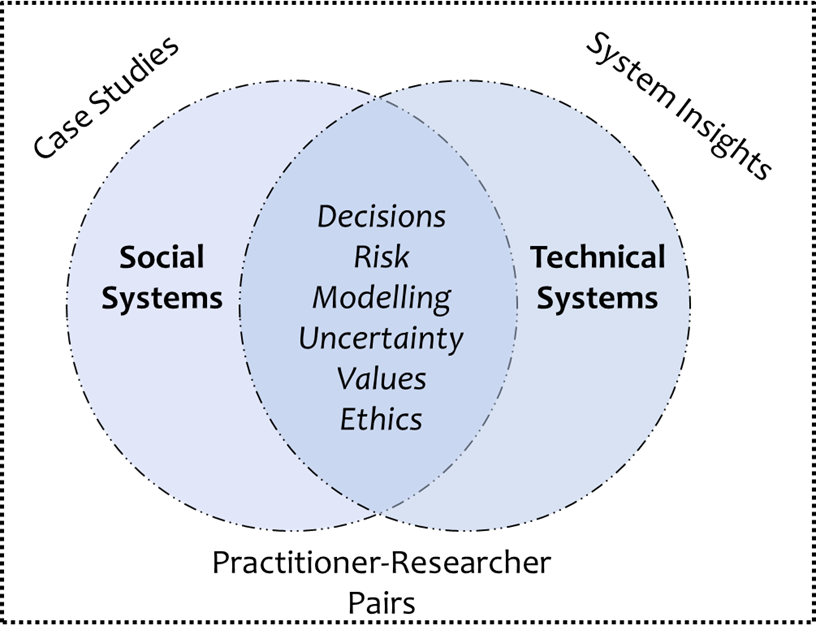
The Special Issue will examine the interaction between social systems and infrastructure systems including their interdependencies, their environmental effects, and ethical issues they raise. Socio-technical systems approaches are both rigorous and useful in practice. Submissions should illustrate how interdisciplinary teams diagnose and act on complex engineering problems using socio-technical frameworks.
A socio-technical systems approach examines the links between social/community processes and technical processes. This could relate to machinery, software, regulations, markets, cultural meaning, and networks of technical operation and social support.
Scope
Authors should address a systems challenge consistent within the scope of Civil Engineering and Environmental Systems:
- Civil engineering optimisation: Cross-disciplinary coordination, efficiency, and socio-technical trade-offs.
- Risk assessment in engineering: Systemic risk identification, mitigation strategies, and real-world risk governance.
- Decision analysis: Multi-actor, multi-criteria, and uncertain decision-making in complex engineering contexts.
- Socio-technical system identification and simulation: Qualitative or numerical models that illuminate how technical components interact with behavioural, institutional, or policy systems.
- Uncertainty: Approaches to assess, manage, and communicate uncertainty to stakeholders.
- Qualitative modelling of wicked problems: Systems thinking applied to resilience, sustainability, safety, and societal trust.
Submission Instructions
Original research articles, review papers, or case studies within this scope are welcomed. All submissions will undergo a rigorous peer-review process to ensure the highest quality of published work.
Select "Applying Socio-Technical Systems Perspectives in Civil and Environmental Engineering" when submitting to the journal's submission site.
Special Instructions for Practitioner–Researcher Teams
Submissions should be authored by collaborative teams consisting of:
- One or more practitioners (industry engineers, project managers, regulatory or policy officials, infrastructure professionals), and
- One or more scholars or researchers (university-based or research-centre-based).
Solo academic papers are permitted only when they include direct data or insights from practice (e.g., interviews, field studies, practitioner co-design). Solo practitioner submissions are encouraged only if paired with scholarly framing, modelling, or analysis, which may involve inviting an academic collaborator before final submission.
Prospective authors in need of co-authors with a different perspective (practitioner or researcher) are encouraged to contact one of the Guest Editors by email.
Author Requirements
A Word file with guidance on the appropriate style will be provided to those who submit an expression of interest.
Expected publication date: mid-2027.
To increase the impact of these practice-oriented articles, we expect (but do not require) authors to pay the fee for open access publication.