

Submit a Manuscript to the Journal
Consumption Markets & Culture
For a Special Issue on
The Exotic States of Americana
Manuscript deadline
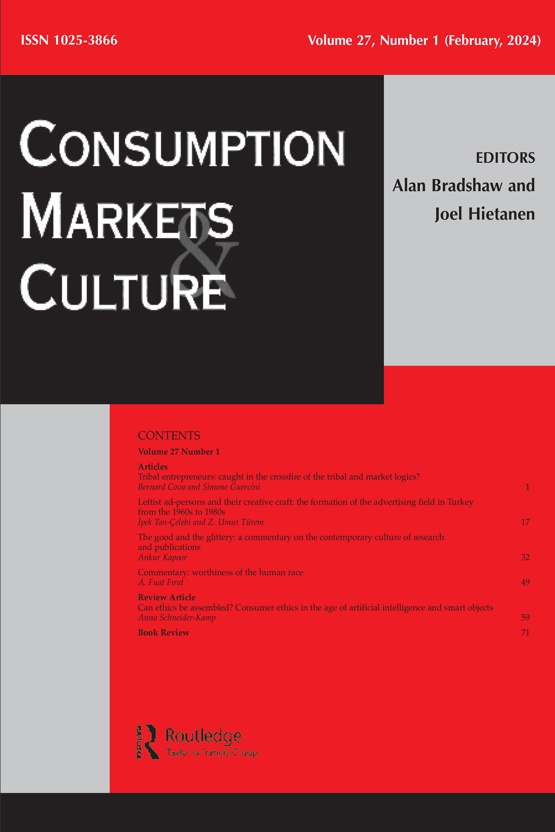
Special Issue Editor(s)
Alan Bradshaw,
Royal Holloway, University of London
[email protected]
Joel Hietanen,
University of Helsinki
[email protected]
The Exotic States of Americana
Special Issue: The Exotic States of Americana
Alan Bradshaw & Joel Hietanen
We could start off by stating the banally obvious. Marketing and consumer research is extremely, irreducibly, and inescapably American on every level. Though the present forms and intricacies of consumer culture certainly vary tremendously across the globe, what lies beneath is irrepressibly North American. This global production of culture shows itself everywhere, and is effectively disseminated in the form of American brands, cinema, series, music, and celebrity culture. The very phenomenon of consumer culture is an American invention and its greatest export by both fortuity and force. Americana, both in terms of the influence of capital and the symbolic production of culture, was in unprecedented ascendancy from the 50’s and 60’s, but today we particularly point to how the neoliberal state apparatus and its associated social form emerged as an impulsive sprawl in the early 80’s Reagan years. This led, in a sombre tone, Félix Guattari to once note how “today there is only one culture, the capitalist culture” (in Guattari and Rolnik, 2008: 33).
Yes, yes, we are of course aware that alternative historicisations are possible; the Qing Dynasty, the Elizabethan court, the Constantinople bazaar, the Industrial Revolution, the post-WW2 German ordoliberalism, the Parisian arcades and so forth; all are important for any materialist historical perspective and nuance. But we say that consumerism in its spirit and ideology, mode of subjectivation, seductiveness and excess, and in its imperialism and its globalisation is largely understood and experienced throughout the globe to be just as Yankee as the US dollar itself.
The way in which consumer culture, the consumer identity, and the consumer individual was an invention to organise both the American post-WW2 industrial capacity and a propaganda to counter communist appeal have been reviewed in our literature before (Holt, 2002; Tadajewski and Jones, 2016; Ward, 2009; Schwarzkopf, 2011)[1]. We are particularly swayed by the early 1929 case of Torches of Freedom, or the moment when Freud’s nephew Edward Bernays convinced women that smoking is not only socially acceptable, but also a desirable sign of emancipation and freedom (also Shankar et al., 2006). What Bernays did was to hire models to attend the feminist Easter Sunday Parade in New York City and to ostentatiously light up in a particularly photogenic moment in front of the press. The narrative had already been prepared earlier for the eager press. Women, through the public act of smoking, were now able to symbolically break sex taboos with their consumption. A raving success – a clear beacon signalling the ascent of uncontainable sign value. It reveals how the symbolic magic of consumption can be readily attached to arbitrary objects, and breaks consumption from any dreary dream of utility decades before marketing theorists tend to write it into history. This moment, however, is also quintessentially American. In its resolute callousness, greed and manipulation – but also its fantastic capacity to attract and channel desires.
Of course, Bernays was no mere advertising man or marketing visionary. He advised American politics and government, spreading US global power and defining US corporate public relations. Through his work, similar to J. Walter Thompson and Ernest Dichter, we see how in USA a blend of advertising, PR, government planning and foreign policy all congeal into an image of American consumerism that would spread across the globe in the form of seductive soft power. Across Western Europe, Japan, South Korea and so on, we this proliferation of what Fidel Castro always referred to as ‘Yankee Imperialism’.
While consumer society may indeed have in many cases been imposed on cultures, this rapid global creep of American capitalism and consumer culture tells also a striking story of its ideological success. To date, we have more than a century of critique of its capacities of increasing inequality, environmental disaster, social atomisation, personal infantilisation, and both anxiety and delirious manias of all kinds. But all the way from Marxist criticisms of class hegemony and exploitation, the Frankfurt School’s notes on the infantilising processes of the culture industry, the contemporary accounts of how consumer culture is pushing the globe to an existential limit, consumption prevails. Today, while Mark Fisher’s (2009) account of a cultural stagnation with a miserable loss of future imaginaries has become increasingly popular, capitalist consumer culture continues to live its best life. All of this points to how, unlike some would have it written, capitalism is not exclusionary; as a proselytising faith it is radically inclusive and has the capacity to adapt to any local setting as long as its constant movement is maintained. Capitalism does not simply ignore or absorb critique – it necessitates it as its very being. This is why critique is largely impervious to it, for it as a relentless discovery process has no clear centre to criticise. These may be some of the reasons why it can be said that the early CCT scholars found, in many ways, such an abiding location from within business schools (Fitchett, 2024). But perhaps what is missing from much of our subject analyses is that where we see the spread of consumer culture, we are also witnessing the spreading of American soft power – its system of material conditions, powers of subjectivation, and endless proliferation through creative destruction with its associated externalities.
In terms of how capitalist consumer culture produces subjects and the social, we are also reminded of a joke by the leftist streamer Hasan Piker: there is indeed something in the American character that allows every, even the most eremite inhabitant from the boondocks, to think upon seeing a strange light in the sky that it must be the aliens that are coming precisely for them. It is this unquestioned pose of universalism that the evident success of the American model has taught both its people and its politics, and it has been learned equally well across all fields of cultural production and commercialisation. The same is true also for the academic message of marketing, which has grown from a study of the transaction to encompass everything in the social realm (Dholakia et al., 2021). In the libidinal production of the socius as consumption, America is the origin, the alpha and omega of a cultural model that everything else must compare itself to. In our field of marketing and consumer research this is also strikingly evident in how all the top journals are American and how those who succumb to the intense disciplinary norms and publish in American journals attract premium salaries across the globe. Everything else, every other form or nuance of culture is only to be evaluated as a derivative, tolerated as exotic spectacles, accepted to take part in the game of radical inclusion. While doubt and criticality grow about the possibilities of capitalism to be able to meaningfully deal with the rising rates of misery, inequality, and environmental catastrophe it is indeed founded upon, a simultaneous impossibility of being otherwise reigns supreme.
Today, this totalising truism is simultaneously increasingly curious. Capitalism, in its 1990’s Fukuyaman ‘end of history’ promised a cornucopia of success and accumulation, indeed where Consumer Culture Theory found its liberatory promise (see Firat and Venkatesh, 1995), but has not this zeal gone distinctly sour? That which was full of cultural optimism seems to now have succumbed into a cyclical misery, growing inequality, endless austerity – a promise that nothing will get better and that it is the duty of the consumer citizen to embrace what will be worse and to continue to enjoy with fervour. Now the promise is an injunction of a necessity, but seemingly any upside has been increasingly occluded. What a strange prophecy exhorting unconditional acceptance. This tendency was also recognised by Deleuze and Guattari (2013) already half a century ago:
Capitalism […] has ceased doubting itself, while even socialists have abandoned belief in the possibility of capitalism's natural death by attrition. No one has ever died from contradictions. And the more it breaks down, the more it schizophrenizes, the better it works, the American way (p. 177, emphasis added).
This special issue, The Exotic States of Americana, denotes a certain sombre feeling of rejection. The affect of the special issue is modelled from the moment when an inebriated drunk suddenly realises to push away the new shot poured in front of them – but certainly not as a permanent measure. What we are looking for are contributions that seek to reverse the exotic gaze, to have a moment of denormalization of the universal. This is a special issue on writing about the American consumer culture as absolutely fantastic, full of its very special delirium, and how it is made up from a gargantuan desert of the real (Baudrillard, 1994). We are looking for texts that analyse this glorious plastic monster, this fierce paper tiger, that has painted the entire world in plasticene.
Yet, this special issue is not intended for moralistic texts nor for repetitions of analyses of globalisation. Instead, we seek the affective, the libidinal, the phantasmatic. As Baudrillard (2010) noted, among:
the monotony of the human species, lies the [American] tragedy of a Utopian dream made reality. In the very heartland of wealth and liberation, you always hear the same question: ‘What are you doing after the orgy?’ What do you do when everything is available—sex, flowers, the stereotypes of life and death? This is America’s problem and, through America, it has become the whole world’s problem (p.30).
Then yet again,
Nothing evokes the end of the world more than a man running straight ahead on a beach, swathed in the sounds of his walkman . . . Primitives, when in despair, would commit suicide by swimming out to sea until they could swim no longer. The jogger commits suicide by running up and down the beach. His eyes are wild, saliva drips from his mouth. Do not stop him (p. 38).
With the second rise of the Trump Empire and the global calamity it unrolls, there is now also a certain limit attitude in view. This is a new sense of a certain inevitability about America, and perhaps it is the very same inevitability that is tied to its constant turbulence and violence, and its potentially impending but likely excruciatingly lingering downfall. As Eric Voegelin put it originally almost a hundred years ago, in particular cultural conditions, vulgarity becomes mesmerising and seductive to people that embody “the pathologies of a diseased society, one beset by economic collapse and hopelessness [where the] demagogue, who is always an idiote, is not a freak or social mutation. The demagogue expresses the society’s zeitgeist, its collective departure from a rational world of verifiable fact” (Hedges, 2025: n/a). Perhaps to recognise America as itself exotic is to also recognise that its ideological grip of the globe is weakening quickly. What these developments will make of America as a cultural hegemony remain to be seen. In this special issue we can speculate.
More specifically, the special issue on The Exotic States of Americana invites contributions on:
· Histories of consumer culture as US soft power
· Flattery and imitation: the keen attempts to reproduce Americana across the globe
· American hegemony and the professionally polished field of consumer culture theory
· Anthropologists, ironically or otherwise, explaining exotic Americana for the benefit of the rest of the world
· Analyses of contemporary modes of Vassalisation (e.g. Hanton, 2025)
· Resistances of all kinds: attempts to counter and break from American consumerism through experiments in commodification and hyper-consumerism (e.g. Mecca Cola)
· Submissions that are polemical, Gonzo, inspired by Baudrillard’s America (1994) or Adorno’s Minima Moralia (2020) or Why I Want to Fuck Ronald Reagan (Ballard, 1968) that are radical of heart and stylistically break with the norms and expectations branded into doctoral students at marketing and CCT bootcamps/workshops and all those other places where indoctrination runs wild
The deadline for submissions is the 30th of June 2026. For any inquiries, please contact Alan Bradshaw ([email protected]) or Joel Hietanen ([email protected]).
Reference
Adorno, T (2020) Minima Moralia: Reflections from a Damaged Life. London: Verso.
Ballard JG (1968) Why I Want to Fuck Ronald Reagan. Brighton: Unicorn.
Baudrillard J (1994) Simulacra and simulation. Ann Arbor, MI: University of Michigan Press.
Baudrillard J (1988) America. London: Verso.
Deleuze G and Guattari F (2013) Anti-Oedipus: Capitalism and schizophrenia. London: Bloomsbury.
Dholakia N, Ozgun A and Atik D (2021) The unwitting corruption of broadening of marketing into neoliberalism: a beast unleashed?. European Journal of Marketing 55(3): 868-893.
Firat AF and Venkatesh A (1995) Liberatory postmodernism and the reenchantment of consumption. Journal of Consumer Research 22(3): 239-267.
Fisher M (2009) Capitalist realism: Is there no alternative?. London: Zero Books.
Fitchett J (2024) Looking back on the fragile extended self. Marketing Theory 24(4): 575-583.
Guattari F and Rolnik S (2008) Molecular revolution in Brazil. Los Angeles, LA: Semiotext(e).
Hanton, A (2025) Vassal State: How America Runs Britain. London: Swift Press.
Hedges, C. (2025, June 6). The rule of idiots. The Chris Hedges Report. Available at https://chrishedges.substack.com/p/the-rule-of-idiots (accessed 15 June 2025)
Holt DB (2002) Why do brands cause trouble? A dialectical theory of consumer culture and branding. Journal of Consumer Research 29(1): 70-90.
Schwarzkopf S (2011) The consumer as “voter,” “judge,” and “jury”: Historical origins and political consequences of a marketing myth. Journal of Macromarketing 31(1): 818.
Shankar A, Whittaker J and Fitchett JA (2006) Heaven knows I’m miserable now. Marketing Theory 6(4): 485-505.
Tadajewski M and Jones DB (2016) Hyper-power, the marketing concept and consumer as ‘boss’. Marketing Theory 16(4): 513-531.
Ward DB (2009) Capitalism, early market research, and the creation of the American consumer. Journal of Historical Research in Marketing 1(2): 200-223.
[1] If one is looking for a more audiovisual experience, search for Century of Self on YouTube to find the excellent 2002 documentary of the origins and history of consumer culture.